Nam Lang (Tham) [MH0057]
19.514729,98.137909
Location
Tham Nam Lang is 3 km southeast of the Nam Khong bridge on the H1095 road. Traditionally the route to the cave involved following the path down the river from behind the Royal Forest Department station, crossing and recrossing the river several times before reaching the junction between the Nam Khlong and Nam Lang rivers. However, since the track to the Susa waterfall has been upgraded a shorter walk in can me made from this track where it reaches the Nam Khong river for the first time at 47Q 408100 2157150. A foot suspension bridge crosses the river and then the path ascends to a ridge which is followed eastwards for 775 m, then north-east and then east for 500 m to the cliff line. The cliff is followed north for 500 metres to the cave entrance which is at the base of enormous cliffs, at the top of a long pile of boulders above the stream resurgence. Posted by Martin Ellis 08/05/20
Description
Survey
The cave was surveyed by the Australian expeditions in 1984 (to 3.5 km), 1985 (stream passage and upper level to total length of 6.7 km, with a 130 metres long measuring rope and legs up to 200 metres!). 1986 (to the terminal choke) and 1988 (upper levels to a 25 m pitch). The location of the survey notes is unknown. Published surveys: DUNKLEY, JOHN ROBERT (1985) - ASF Grade 4.3 DUNKLEY, JOHN ROBERT; BRUSH, JOHN B. (ED.) (1986) BOLAND, KEN (1992b) ELLIS, MARTIN (2009) - based on survey in DUNKLEY, JOHN ROBERT; BRUSH, JOHN B. (ED.) (1986) SIDISUNTHORN, PINDAR; GARDNER, SIMON; SMART, DEAN (2006) Ellis, Martin; Laumanns, Michael (2017)
Fauna
Paratachycines (Paratachycines) thailandensis Gorochov, 2002 (Arthropoda, Insecta, Orthoptera, Rhaphidophoroidea, Raphidophoridae) û type locality (Gorochov 2002) Schistura oedipus (Kottelat, 1988) (Chordata, Actinopterygii, Cypriniformes, Balitoridae) û type locality (Kottelat 1988)
General description
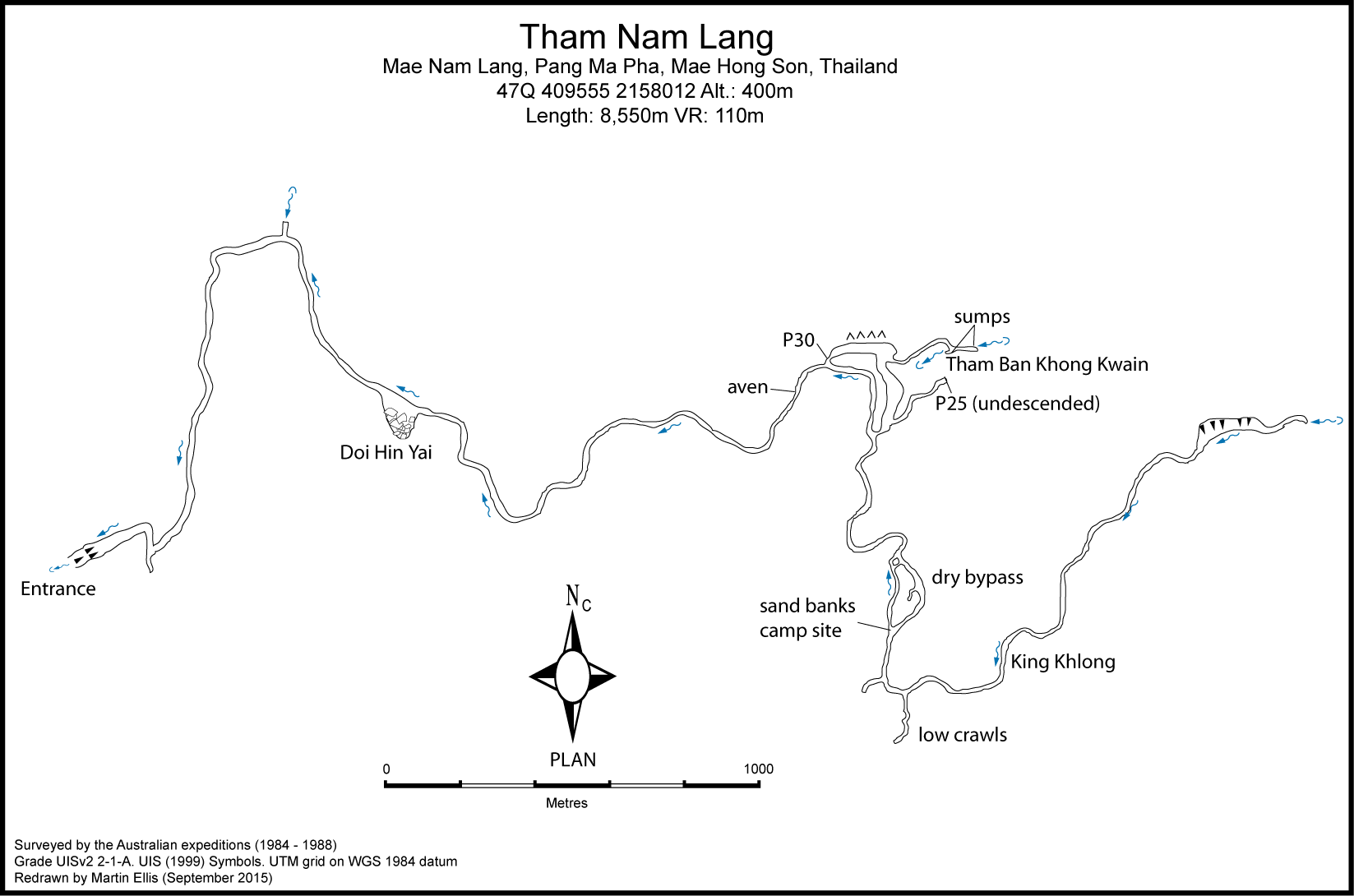
The entrance chamber, 50 m wide, 30 to 40 m high and 80 m long, has a large boulder slope that descends down to the river. The river passage can be followed upstream to the limit of daylight over 200 m into the cave. A climb is then soon required over a flowstone barrier and gours nearly 60 m wide. The stream is then regained and can be followed continuously for 5 km and then intermittently for another 1.6 km. The streamway is very constant in width being 10 to 20 m wide. The roof heights have been estimated at never less than 10 m, usually over 20 m and sometimes reaching 80 to 100 m and in places the line of sight reaches 200 m. For the first kilometre the cave is strike controlled. In the first 3 km the floor is occasionally bedrock, but is usually meandering stream channel between sand and gravel banks. There are regular rockfalls up to 6 to 8 m high and a few hundred metres long. Between 3 and 6 km from the entrance there are long stretches of slow moving water up to 1.5 m deep with large deposits of mud. Near the 5 km mark the cave shows signs of flooding to the roof. At the upstream end of this area the cave briefly narrows and the ceiling drops to within a few metres of the water before opening up again. Large expanses of flowstone and gours are found 0.3 km (Tham Khang Khao) and 1.3 km (Phra Racha Wang Mekhala) from the entrance forming ramps up to 10 m above the stream. Both flows are formed by small seasonal inlets. Several other similar inlets occur, most of which close down after about 50 m though one near the 5 km mark can be followed southwards for 255 m. The extensive, unstable, rockfalls suggest that the cave has higher levels. The first rockfall is 1.1 km into the cave and has not been thoroughly explored, but has been climbed to a height of about 50 m. The second rockfall, Doi Hin Yai, is 1.8 km into the cave. This rockfall is 120 m long, 80 m wide and from the top, at 50 m, a large shaft (Ban Khong Ramasura) extends upwards beyond the limit of caving lights. The trickle of water and fresh vegetation suggest a connection with the surface which is about 300 m above. The most extensive upper level series is the Tham Ban Khong Kwan series. This starts with a steep rubble slope just before the 4 km mark. From a trunk passage about 50 m above the stream a chamber to the east gives access to at least one large passage that ends at an undescended 25 m pitch that draughts strongly. From the downstream end of the trunk passage a very well decorated and large chamber (Sala Khan Thai) leads off to the left. At the western end of the chamber there is an estimated 30 m pitch back into the streamway while at the other end a muddy passage 5 m in diameter leads to a small inlet (Huai Khwae Noi) which sumps at both ends. Back in the main streamway, from the boulder slope up to Tham Ban Khong Kwan, the stream passage continues with gravel banks. The deep water shallows at a point beneath a huge fissure ascending up into the roof which has a rockfall below and a large chockstone wedged across the rift 10 m above the floor. Deeper pools are then met in the streamway until a rockfall is reached which blocks the full width of the passage. 10 m above the stream a dry bypass starts. This bypass passage is 20 m wide by 20 m high. At the upstream end of the dry bypass there are sandy banks. This area has been used as a campsite to explore the far reaches of the cave. Upstream of the campsite the stream passage continues to a flat, gravel floored, section where the 255 m long inlet comes in from the south. Beyond this inlet the stream passage reaches a bench (another possible campsite), an area of columns on the left and a large flowstone which overhangs the stream. This is the start of a deep, swift flowing section known as King Khlong. The passage is 6 m wide and 15 m high with sharply scalloped bedrock floor and walls. However, ledges above the stream help with crossing this area. The stream makes a 90¦ bend (where there is a possible side passage) then widens to 30 m and the roof rises to 30 m. The next section has rockfalls across the stream in two places and widens further to 15 m with large columns on the right (where, again, there may be an upper level). Beyond here the streamway narrows and increases in gradient with several rapids. After 250 m there is a rockfall of large boulders which is nicely decorated with a large stalagmite. Descending the far side of the rockfall regains the stream, but it emerges from another rockfall on 30 m further on. This rockfall is in a very high rift and the boulders have been climbed without reaching the top of the roof. This boulder choke is very unstable. Towards the east the rockfall leads to a section of decorated upper level with several descents between the boulders back to the stream. After a short section in the rocks a solid stream passage was reached, about 6 m wide and 4 m high. After 80 m this ended at a deep pool with a 0.5 m waterfall on the far side where the stream comes out of a slot 0.6 m wide. This obstacle has been passed to reach another 30 m of stream passage to a point where the stream emerges from beneath a 4 m high boulder. To the left a boulder slope has not been pushed. At this furthest point it is only about 500 m to the sink of the Nam Lang river. Posté par Martin Ellis 08/05/20
Documents
[Topo] Tham Nam Lang 12/05/2019Bibliographie relative à l'entrée n°29969 : Nam Lang (Tham) [MH0057] 08/05/2020
- +ANONYMOUS. (1997b) "Forward Program: Mini Expedition to North West Thailand" Speleo Spiel No. 303 July-August 1997 p3 +ANONYMOUS. (1998e) "Cave Town" The Asian Tribune Vol.1 No. 8 1-7 June 1998 p28 +ANONYMOUS. (2011b) "Baseline study for ecotourism development in Mae Hong Son" Final mission report by Thailand Community Based Tourism Institute (CBT-I) for the United Nations Joint Program on Integrated Highland Livelihood Development in Mae Hong Son, Output 1.3: Ecotourism. June 2011. 175p +BOLAND, Ken (1989) "Under the Triangle - Thailand 88" Nargun Vol. 21 No. 10 pp90-95 +BOLAND, Ken (1992a) "Caving in Thailand" Australian Caver No. 132 pp7-9 +BOLAND, Ken (1992b) "NW Thailand - The Story So Far" International Caver No. 5 pp30-35 +BOROWSKY, Richard (1997) "Northern Thailand, the caves of Mae Hong Son" Met Grotto News April 1997. Abstracted by National Speleological Society in Speleo Digest 1997 p326 +BOLGER, Terry; ELLIS, Martin (2018) "An overview of caves and caving in Thailand" Journal of the Australasian Cave and Karst Management Association No 110 pp32-37 +BOROWSKY, Richard (2000) "Thailand 2001 - Expedition Prospectus" www.nyu.edu/fas/cave/ExpeditionPlan.pdf +BOROWSKY, Richard; MERTZ, Lisa (2001) "Genetic Differentiation Among Populations of the Cave Fish Schistura oedipus (Cypriniformes: Balitoridae)" Environmental Biology of Fishes Vol. 63 Nos. 1-3 pp225-231 +BOURKE, R.M. (1985) "Tha´lande" Spelunca No. 19 p16 +COGGAN, Marjorie; DUNKLEY, John Robert; ANDERSON, Neils (EDS.) (1999) "Tham Sanuk: The Lighter Side Of Caving In Thailand" Canberra, 76pp +DILOKWANICH, Sittipong; et Al. (2000) "An Exploration and Database System of the Caves, Mae Hong Son Province" 6 Vols. Faculty of Environment and Resource Studies, Mahidol University, Bangkok - STD650 +DUNKLEY, John Robert (1983) "Karst and Caves of Thailand: A Reconnaissance Report" Proceedings 14th Biennial Conference Australian Speleological Federation pp146-150 +Dunkley, John Robert (1985a) "Karst and Caves of the Nam Lang - Nam Khong Region, North Thailand" Helictite Vol. 23 No. 1 pp3-22 +DUNKLEY, John Robert (1985) "Further Under The Golden Triangle" Australian Caver No. 108 pp2-5 +DUNKLEY, John Robert (1995) "The Caves of Thailand" Speleological Research Council, Sydney ISBN 0-9589253-9-9 +DUNKLEY, John Robert; BRUSH, John B. (ED.) (1986) "Caves of North-west Thailand: Report of the Australian Speleological Expeditions 1983-1986" Speleological Research Council, Sydney ISBN 0-9589253-2-1 62pp +DUNKLEY, John Robert; GREENFIELD, Paul (1983) "Under the Golden Triangle: Caving in North Thailand" Australian Speleological Federation Newsletter No. 102 pp4-6 +Dunkley, John Robert; Kiernan, Kevin (1987) "The Australian Speleological Expeditions to Thailand 1985-1986" Helictite Vol. 25 No. 2 p58 +ELLIS, MARTIN (2009) ôThailandÆs Top Twentyö Shepton Mallet Caving Club Journal Series 12 No. 4 pp140-232 +ELLIS, Martin (2015c) "Thailand's Longest and Deepest Caves: A Caving Guide" Martin Ellis, Shepton Mallet ISBN 978-1-326-43857-9 84pp +ELLIS, Martin; Laumanns, Michael (2017) "Thailand" in Laumanns, Michael; Price, Liz (eds.) (2017) "Atlas of the Great Caves and Karst of Southeast Asia: Part 2 Myanmar - Vietnam" second edition, Berliner Hohlenkundliche Berichte Band 67 pp241-292 +FERNANDEZ, Dani (2017) "De cuevas por el Sureste Asißtico. Cap. 2. EspeleologÝa en Tailandia" Club Abismo Grupo Espeleol¾gico 14 September 2017 +FOAKES, Martin (1998) "Caving in North-West Thailand" International Caver No. 22 pp32-35 +GOODDEN, Christian (2002) "Three Pagodas" 2nd revised & expanded edition, Jungle Books (Halesworth), England ISBN 0-9527393-4-1 448pp +GOROCHOV, A.V. (2002) "Data on Fauna and Taxonomy of Stenopelmatoidae (Orthoptera) From Indochina and Other Territories: III" Entomological Review Vol. 82 No. 7 pp765-781 +HAIR, Will (1999) "Notes from the Underground" Sawasdee (Thai Airways Magazine) April 1999 pp36-40,42 +KIERNAN, Kevin (1988a) "Beneath the Golden Triangle" Asia Wise August 1988 pp4-5 +KIERNAN Kevin (1988e) "Geomorphology of a tropical intermontane basin in the Sino-Burman Ranges" 26th International Geographical Congress 1988, International Geological Union, Sydney pp1-24 +KiIERNAN, Kevin (1991a) "Geomorphological evidence for Quarternary climatic change in the Lower Sino-Burman Ranges" Singapore Journal of Tropical Geography Vol. 12 No. 2 pp112-123 +KIERNAN, Kevin (1991b) "Tropical mountain geomorphology and landscape evolution in North-west Thailand" Zeitschrift f³r Geomorphologie N.F. Vol. 35 No. 2 pp187-206 +KOTTELAT, Maurice (1988) "Two Species of Cavefishes from Northern Thailand in the Genera Nemacheilus and Homaloptera (Osteichthyes : Homalopteridae)" Records of the Australian Museum Vol. 40 No. 3-4 pp225-230 +KOTTELAT, Maurice (2012) "Conspectus cobitidum: An inventory of the loaches of the World (Teleostei: Cypriniformes: Cobitoidei)" The Raffles Bulletin of Zoology Supplement No. 26 199pp +KREUSS, Markus (2014) "Thailand" www.troglophil.de/?section=location&id=25 (german) [accessed April 2015] +KUSCH, Heinrich (1990) "Die lõngsten und tiefsten H÷hlen S³dostasiens (Stand 1988)" Die Hohle Vol. 41 No. 1 pp11-16 +LAUMANNS, Michaël; PRICE, Liz (2011) "A General Assessment of the Great Caves and the Karst of Southeast Asia" Proceedings of the Asian Trans-disciplinary Karst Conference, Yogyakarta, Indonesia 7-10 January 2011 pp404-419 +MIDDLETON, John; WALTHAM, Tony (1986) "The Underground Atlas" Robert Hale Ltd. reprinted (1992) The Promotional Reprint Co. Ltd., Leicester ISBN 185648-045-3 pp187-188 +PRICE, Liz (1988) "Whitsun Under The Golden Triangle" Cerberus Spelaeological Society Journal Vol. 18 No. 3 pp65-68 +SANDJIDEH, Kian (1996) "Read on the net" SFBC Newsletter Vol. 39 No. 9 September 1996, San Francisco Bay Chapter, National Speleological Society, p4 +SIDISUNTHORN, Pindar; GARDNER, Simon; SMART, Dean (2006) "Caves of Northern Thailand" River Books, Thailand, ISBN 9749863135 +SPIES, John (1994) "The Palaces of Darkness" Action Asia (Hong Kong) Vol.3 No.4 pp116-126 +SPIES, John (1997) "The Values and Vulnerability of the Caves and Karst Resources in Mae Hong Son Province, Thailand" Journal of Ecology Vol. 24 No. 3 pp41-48 +SPIES, John (1999) "Managing the cave and karst resources in the Nam Khong and Nam Lang catchment, Northwest Thailand" Proceedings of the Conference on Cave Resources, Bangkok, 4-5 August 1999, pp190-202 +SPIES, John (2002) "Under The Golden Triangle" in O'REILLY, JAMES & HABEGGER, LARRY (EDS.) "Travelers' Tales Thailand" Travelers' Tales, ISBN 0885211759 pp324-333 +TRAJANO, Eleonora; MUGUE, Nikolaï; KREJCA, Jean; VIDTHAYANON, Chavalit; SMART, Dean; BOROWSKY Richard (2002) "Habitat, Distribution, Ecology And Behaviour Of Cave Balitorids From Thailand (Teleostei: Cypriniformes)" Icthyological Exploration of Freshwaters Vol. 13 No. 2 pp169-184 +WEARE, Robin (2014) "Mud maps and caves in Thailand" presentation at Hidden Earth 2014 +WHITE, Tony (1988) "Zen and The Art of Umbrella Pointing" Caves and Caving No. 40 pp14-17 +WIGFALL, Mark (1988) "Cave Lodge, Northern Thailand" Shepton Mallet Caving Club Journal Series 8 No. 5 pp202-205
Histoire
Despite its size Tham Nam Lang was apparently not well known locally, being about 4km from the nearest village 1984-01 first recorded visit beyond the spectacular entrance chamber was by the Australians. Further exploration occuring on the 1984, 1985, 1986 and 1988 Australian expeditions, since when only minor advances have been made. 1988 J. Brush, N. Anderson - descended pitch in upper series to 100 m of passage to sump. 2018 R. Gardner 2019-03-02 J. Brush, N. Anderson, M. Coggan
Cavités proche
| Distance (km) | Nom | Longueur (m) | Profondeur (m) |
|---|---|---|---|
| 0.0 | Nam Lang (Tham) [MH0057] [doublon de #29969, à fusionner puis supprimer] | 8550 | 110 |
| 0.4 | Pha Nam Lang (Tham) [MH0058] | 20 | 0 |
| 0.6 | Pha Tao Daeng Overhang [MH0270] | ||
| 1.7 | Cave MH0204 - MH0204 | ||
| 1.7 | Coffin Cave MH205 - MH0205 | ||
| 1.8 | Cave MH0113 - MH0113 | 200 | |
| 2.5 | Tham Sa Tho - MH0135 | ||
| 2.8 | Yin Lee Nan Nam (Tham) [MH0230] | ||
| 3.0 | Nam Bor Phi - MH0017 | 106 | 106 |